

How To Set Up An Amp For Guitar
Amplifier settings and controls can exist super confusing, especially for a beginner, but even for more experienced guitarists who accept recently purchased a new amp. Information technology'southward hard to know what everything means, and what it does to your sound.
So in this article I'll go through all the controls on guitar amplifiers, explain what they hateful, and how they modify your audio. Then I'll leap into some presets you tin endeavor and explain exactly how to punch in the perfect tone. And then permit's go started!
Basic Amplifier Controls
And so let'due south kick off this guide by going through all the primary controls you'll find on nearly amplifiers and explain what they mean. They are:
- Volume
- Gain
- Bass
- Mids
- Treble
- EQ or Tone
- Contour
- Presence
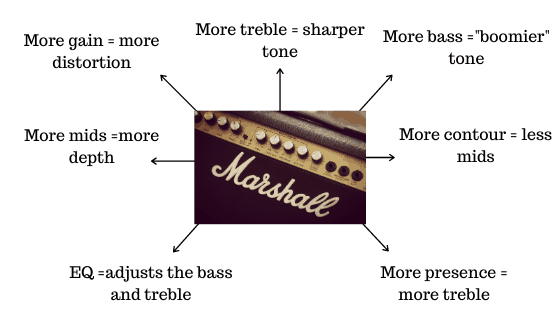
volume
And so this one is pretty obvious. There are usual 1 or two book controls on an amplifier. If you lot only have i volume control, it'll just human activity every bit a main volume control. But if you have 2, then normally ane is to control a clean aqueduct, and the second is to control the distorted channel.
gain
So to properly understand the term proceeds, you lot need to know how the amplifier works. Don't worry, it won't get as well technical, but acquit with me.
When an amplifier processes the signal that comes from your guitar'southward pickups, it goes through ii stages. The get-go phase is called the "preamp". This is what controls the gain setting. And then if you turn this upwardly high, it causes the preamp to work harder, resulting in a more distorted tone. The second stage is the poweramp phase. This controls the overall volume.
Of course, in that location are cases where y'all'll want a lot of gain, for example, if y'all're playing heavy metal. And at that place are as well cases where you'll want less gain, or none at all, for example in a lot of state music.
Ane matter to point out though, is that often you actually need less gain than you think you will. Having too much proceeds can cause your tone to sound muddy. So it's always best to commencement with a lower proceeds setting, and piece of work up to where you need to be.
bass
The bass command on your amplifier determines the amount of low-frequency sound you'll hear through your amplifier. If yous desire to give your tone a "boomy" sort of presence, then you'll want a higher bass setting. But if you prefer a more balanced and even tone, and then set your bass to around halfway and work from their.
mids
Mids, refers to the amount of mid-range frequencies you hear through your speaker. If you have a higher mids setting, your tone will sound more full and take more depth. A high mids setting will terminate the sound of your guitar getting lost when you're playing in a band with other instruments.
The chief purpose of guitars in a band are to provide the mid-range frequencies, so it's very rare that you should accept this setting on low. On near amplifiers, you'll want your mids setting to be on at least four, just frequently effectually vi for a lot of styles of music.
treble
Treble refers to the amount of high frequency audio you hear through the speaker. Treble frequencies make your tone sound sharper and more crisp. If you lot want to have perfect note separation, and then you'd have the treble quite high. However, if y'all turn it up too high, it can outset to sound a bit harsh.
Usually, a higher treble setting is used for lead guitar rather than rhythm guitar. This is because lead guitar needs to cutting through the mix a bit more than rhythm guitar, which generally uses a lower treble setting to sound a bit more mellow and warmer.
EQ or Tone
Some guitar amplifiers don't have separate treble, bass and mids controls, and instead have an EQ (equaliser) or tone command. Using these controls have a similar effect to adjusting the treble and bass. If you lot plough the control up, and so y'all'll put more than emphasis on the treble, making your guitar sound sharper. If you turn the tone/ EQ control down, then your tone volition become more mellow.
It's actually hard to say what your EQ or tone command should be on, because it varies so much between amplifiers. Then the all-time advice I can give you, is to showtime at halfway, then slowly adjust downwards, and so slowly accommodate back up. You should detect the sweet spot you lot're later on if you're patient with this.
As a general dominion, you lot'll want to identify more than emphasis on the bass if you lot're playing rhythm guitar, and more on the treble if you're playing lead guitar, only that's a very simplistic overview.
Contour
This control is found on most Marshall amps and only refers to the mids. However, it is actually the opposite mode circular to what you lot'd usually expect. And then if you increase the contour, y'all volition be decreasing the mid-range frequencies. And if y'all subtract the contour, you lot'll be increasing the mids. A high profile setting sounds nearly "scooped".
Presence
This is another command unremarkably found on Marshall amps and information technology's used to command the higher frequencies similar the upper-mids and treble. If you lot increase the presence, the tone will sound sharper and livelier. If you decrease it, the tone will be more mellow.
What are Amplifier Channels?
Another thing yous may be wondering about your amplifier, is what the different channels practise. Often y'all'll see a lot of amplifiers with two channels: one that's clean and some other that'due south overdriven or distorted.
You tin use these to easily switch between a clean and distorted tone, simply without messing with your gain setting. Information technology'due south peculiarly handy when you lot plug a foot-switch into your amp (which a lot of amps allow), to easily change between the channels.
clean
The clean channel will accept little to no gain, depending on the exact amplifier you're using. Still, on a lot of amps, y'all tin can still arrange the gain control. If yous increase information technology, then you'll become a kind of overdriven tone, but you lot won't get thick distortion. I sometimes set my amp on a clean channel and so crank up the proceeds in society to get a crunchy, saturated tone.
distorted
If you set the aqueduct to distorted, then you'll get a big boost of gain. This is very useful for metallic and hard rock. You can so suit the gain control in order to become from a more than overdriven and crunchy tone, to pure distortion.
number of channels
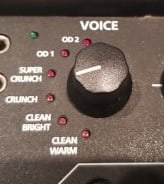
Like I said earlier, a lot of amplifiers have two channels, one clean and one distorted. But some accept more. My do amplifier, from the Blackstar ID Core Serial, has 6 channels. Ii clean (1 warm, one bright), ii overdriven, and two distorted.
Guitar Amp Furnishings
Okay, so now nosotros've been through all the principal control y'all'll find on your amplifier, we'll leap into some of the others you might see. Your amplifier may accept all of these, but some, or not at all. Their function isn't to adjust the tone as much as the basic controls, only to add some interesting effects.
If your amp doesn't take these features, so you may desire to look into some effects pedals to give you the same result. Check out this quick guide to guitar furnishings pedals to find out a chip more than.
Simply for now, let's get started with the virtually mutual amplifier furnishings:
- Reverb
- Delay
- Phaser
- Chorus
- Flanger
- Octaver
- Tremolo
reverb
Reverb is one of the almost basic effects, but information technology has such a big impact on your guitar'due south tone. Reverb occurs naturally all the time, it's merely caused by soundwaves reflecting off surfaces. And so remember about the kind of sound effect you get if you were to shout in a huge empty hall. It causes a kind of echo result correct? Well, that's reverb.
And so what does it do for your tone? Well, reverb tends to give your tone a lot more presence and depth. Information technology's great for loads of different situations, from adding a bit of affect to your solos, to just giving your rhythm playing a boost.
In that location are 5 main types of reverb. Some amplifiers let y'all to switch between the types, and others simply allow you to control how much reverb you hear. Here are the principal types:
- Room: this is the most subtle type of reverb. It's nigh then subtle, that if you accept it on adequately low, y'all will really have to listen for it.
- Hall: this makes the reverb more obvious, since it's supposed to mimic the natural reverb that occurs when you play in a hall.
- Sleeping room: this differs from hall reverb, considering it mimics a smaller space, resulting in more clarity, and makes it sound less airy.
- Plate: this reverb blazon mimics the sound you become if a sound wave hits a plate of metal. This type of reverb sounds smooth and lasts for a longer time.
- Spring: this blazon of reverb sounds more wobbly, hence mimicking the way a spring moves. The reverb is less smooth than plate reverb.
delay
Delay effects cause a note to exist taken and repeated back. This works for both chords and individual notes. It's a great upshot to add in when you're playing solos. However, you take to be conscientious with delay effects, equally if you make them also prominent, your audio volition become a bit of a mess.
Unless your amplifier only has a single command to adjust the delay, so y'all'll normally be able to control the post-obit parameters:
- Fourth dimension: this is the length of fourth dimension information technology takes after the notation is played, for the delay effect to kicking in.
- Level: this refers to the volume of the delay effect.
- Feedback: this refers to the amount of repeats you'll hear.
phaser or flanger
Phaser and flanger furnishings are pretty hard to explain. The all-time way to describe them, is by saying that they create a kind of whooshing sound. Phaser and flanger effects are pretty similar. That's why most amplifiers will only have i of the 2. The only real departure is that a flanger effect sounds a chip more than artificial.
chorus
This effect is pretty unproblematic, just is really useful, especially during solos. It simply causes it to audio like multiple guitars are playing at the aforementioned time. The result, is more depth, presence and liveliness to your tone.
octaver
This consequence changes the pitch of your guitar. It can cause it to increase or decrease an octave. This is useful if you want to change the pitch without adjusting the tuning. It's also good if you want to try and brand a standard electric guitar sound more like a bass guitar.
tremolo
Tremolo effects mimic the sound you lot become if you use a tremolo arm on your guitar. It'south peculiarly helpful if you have a fixed bridge, merely nonetheless want to attain a vibrato type effect.
Getting the Nigh out of your Amp
So now you know about the basic controls, effects, and channels on an amplifier, you lot're probably wondering how everything comes together to give you the all-time sound. So here'southward a step-by-pace guide to getting the best clean, overdriven and distorted tones, on any amplifier.
If you lot want some more tips, then cheque out this post I've written that takes you lot through 7 tips to make your amp sound improve.
How to Get the All-time Clean Tone
If yous're looking to go a crystal clear clean tone on your electric guitar amplifier, then follow these steps.
- Set your amp to the make clean aqueduct if information technology has one.
- Plow the gain control all the fashion down. Some amplifiers are designed then that the volume completely disappears if you lot take the gain on 0, so if that'southward the case, accept it on 1 instead.
- Side by side, adjust the mids, treble, bass (or EQ/tone) to midway. If y'all feel like you need more depth, increment the bass. If you feel similar you need more than clarity and ameliorate annotation separation, then increase the treble. Or, if y'all experience like your tone is getting lost amongst other instruments, the increase the mids.
- Add some light reverb.
- Play about with whatsoever other furnishings similar delay or chorus if yous demand to.
How to Get the Best Overdriven (Crunch) Tone
Overdriven crunchy tones are used by loads of bands, particularly those who play rock 'northward' roll or dejection mode music. Here's how to suit your amplifier to become the best overdriven tone.
- Figure out what channel you need. If you take an overdriven channel, then keen, use it! Merely if you simply have a clean or distorted channel, you lot'll need to make a determination. If your make clean aqueduct has little to no gain, whatsoever, and so get with your distorted aqueduct. The key is to take plenty gain so that it sounds crunchy, but not heavy.
- Adapt the gain control. If you're using a distorted channel, then you lot'll probably want to showtime with the gain on around three, and adjust upwardly from at that place. If yous're using a clean channel, and so you'll usually need your proceeds to be on effectually eight, mayhap even higher.
- Gear up your treble, mids and bass to midway. Follow the same steps every bit y'all would to get a adept clean tone. Increase the treble if you need more sharpness, increase the bass if you lot need more of a depression-cease boost, and increase the mids if you need more depth.
- Add some light reverb.
How to Go the Best Distorted Tone
Now nosotros'll move onto how to get that thick, heavy distorted tone that'south commonly associated with metal and heavy rock music.
- Use the distorted channel on your amplifier.
- Adjust the gain control. You'll probably demand it on around vi or higher, but be careful non to go too high. You demand to go the balance betwixt being able to hear notes changing, and having that high level of gain.
- Now, you can adjust your treble, bass and mids. If you're struggling to get enough note separation and clarity, but can't turn the gain downward, or you'll lose all the sustain, then increase the treble. You'll want the mids to be ready so your tone doesn't audio "scooped" and can be heard amongst other instruments. The bass can be increased to give you a "boomy" quality.
- Add in whatsoever effects you lot demand similar reverb, delay, chorus etc.
Amp Setting Examples
Okay, so I know that a lot of guitarists simply want to jump online and notice the perfect amp settings for stone, blues, metal, state etc. Still, unfortunately it'due south not that simple.
In that location really isn't a one size fits all for amplifier settings considering there are so many variables involved. What sounds perfect on ane amplifier, can audio completely wrong on some other.
With that said, I empathize that for a complete beginner, information technology can be actually hard to know where to start, even with the information I've given you already. And then in the next function of this mail service, I'g going to get through some suggested amp settings for different styles of music. Withal, these are only supposed to be used every bit a starting betoken.
Start with these amp settings if you're really unsure where to brainstorm, and and so have another read of what the different controls hateful, and arrange from there. It'due south a lot of trial and fault, then exist patient, it gets easier the more y'all do it.Remember to just adjust ane control at a time, then listen carefully to the impact it makes on your tone.
Amp Settings for Rock
It's difficult to pick some general settings for rock music, considering it varies so much and there are and so many different types of rock. But generally, you desire the gain on effectually 6 to give you plenty distortion and crunch, but without affecting the clarity. The treble, mids and bass are all usually quite balanced. You'll also commonly benefit from a bit of depression level reverb to requite your tone some more than presence.
Check out this mail service on the best amplifier settings for stone music to learn more.
Amp Settings for Metal
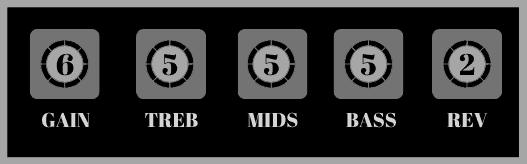
Of course, with heavy metal, you'll want the gain cranked up pretty high. In club to compensate for then much distortion, you lot'll want the treble moderately high in gild to requite you that boost of clarity to overcome the muddiness of the distortion. The mids and bass will usually be fairly balanced and a fleck of reverb will give your tone so more character.
Amp Settings for Blues
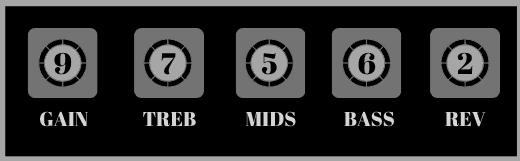
You don't want the gain to be very high for blues, every bit you lot're looking for a more saturated and crunchy tone, rather than a distorted one. The treble and mids are adequately moderate to requite a balanced sound. The bass shouldn't exist that high because y'all don't desire your tone to accept a particularly "boomy" quality. Yous'll normally benefit from some reverb to brand the single notes stand out a bit more.
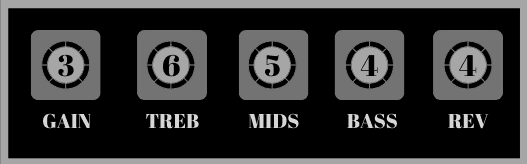
Amp Settings for State
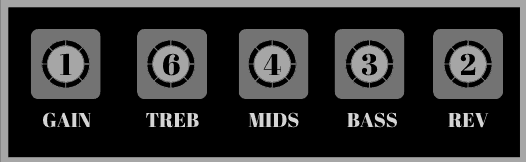
Y'all'll usually desire a clean tone for land music, and then take the gain as low equally you can without losing all the volume. To give you lot that twangy country tone, have the treble moderately high. The sound is usually more scooped with country music than other styles, then take the mids moderately depression, and the bass turned downwards a bit more.
I have loads more than amp settings guides for dissimilar styles of music and fifty-fifty for different bands. Cheque out more amp settings guides.
Source: https://prosoundhq.com/guitar-amp-settings-and-controls-a-step-by-step-guide/
0 Response to "How To Set Up An Amp For Guitar"
Post a Comment